

The book teaches.
The workbook makes it stick.
Marks are earned with a pen. Each workbook follows its book chapter by chapter with 1,878 new practice items across the series — warm-ups, drills, exam-style questions with real answer space, trace tables, fix-the-mistake and mark-it-yourself pages. A4, made to be written in.
- practice items
- 1,878
- marks of practice
- 4,418
- trace tables to fill
- 122
- A4 pages to write on
- 920
Why write it down
Reading feels like revising. Writing is.
Recalling beats re-reading
Students who practised recalling a passage remembered more a week later than students who re-read it — even though the re-readers expected to do better (Roediger & Karpicke, 2006). Every workbook chapter starts with recall.
Spaced and mixed
A review of ten study techniques rated practice testing and spaced practice the two most useful, and highlighting and re-reading among the least (Dunlosky et al., 2013). Warm-ups bring back earlier chapters on purpose.
Marking teaches the scheme
Marking a sample answer against the scheme shows what earns the mark and what loses it. Fix-the-mistake pages are built from the errors examiners report, in our own words.
Every chapter
Eight steps from “I've read it” to “I can do it”.
- 1
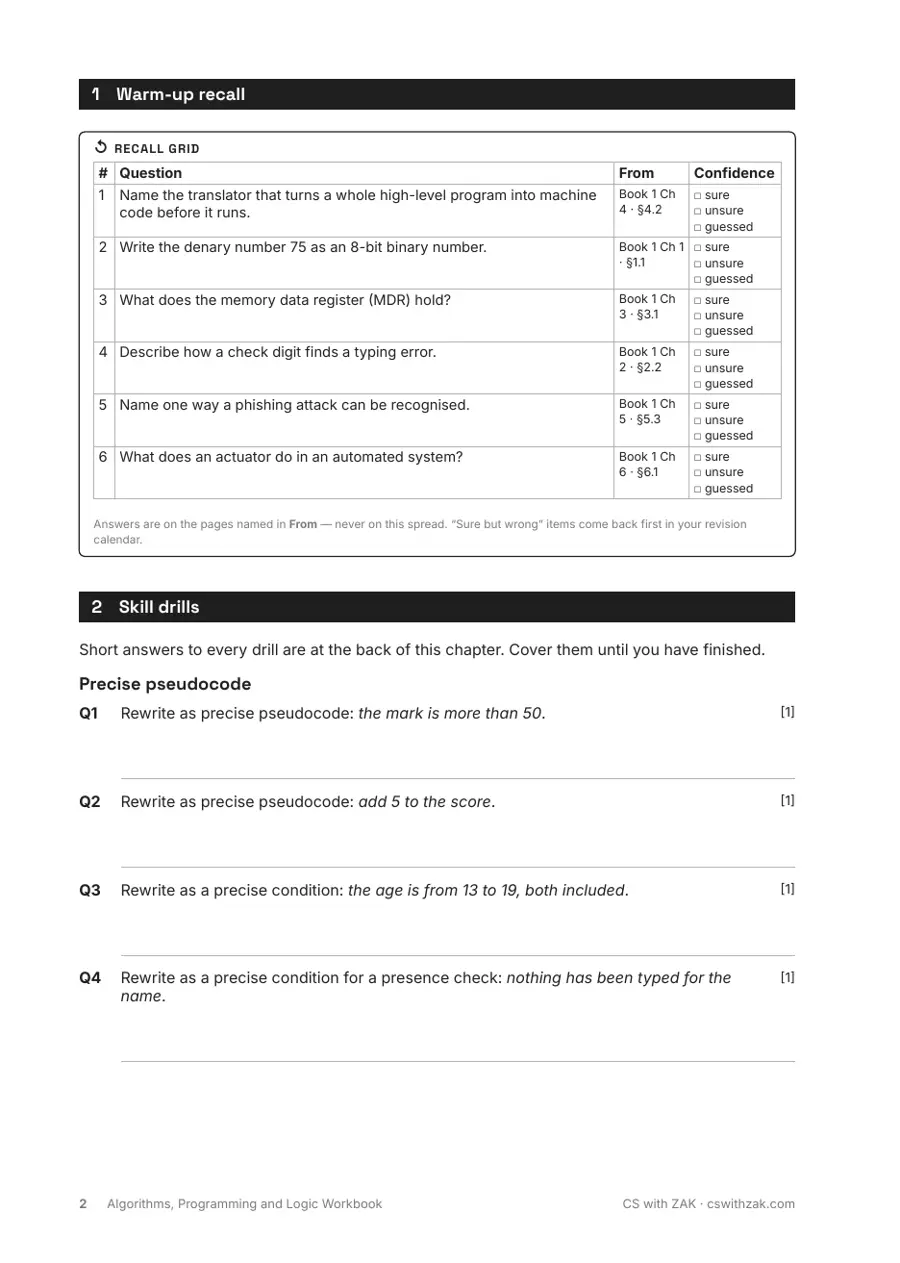
Warm-up recall
Questions from earlier chapters, answered from memory, with a confidence tick — so last week's topic doesn't fade.
- 2
Skill drills
Short, graded write-in practice: convert, complete, rewrite as precise pseudocode. Short answers at the back.
- 3
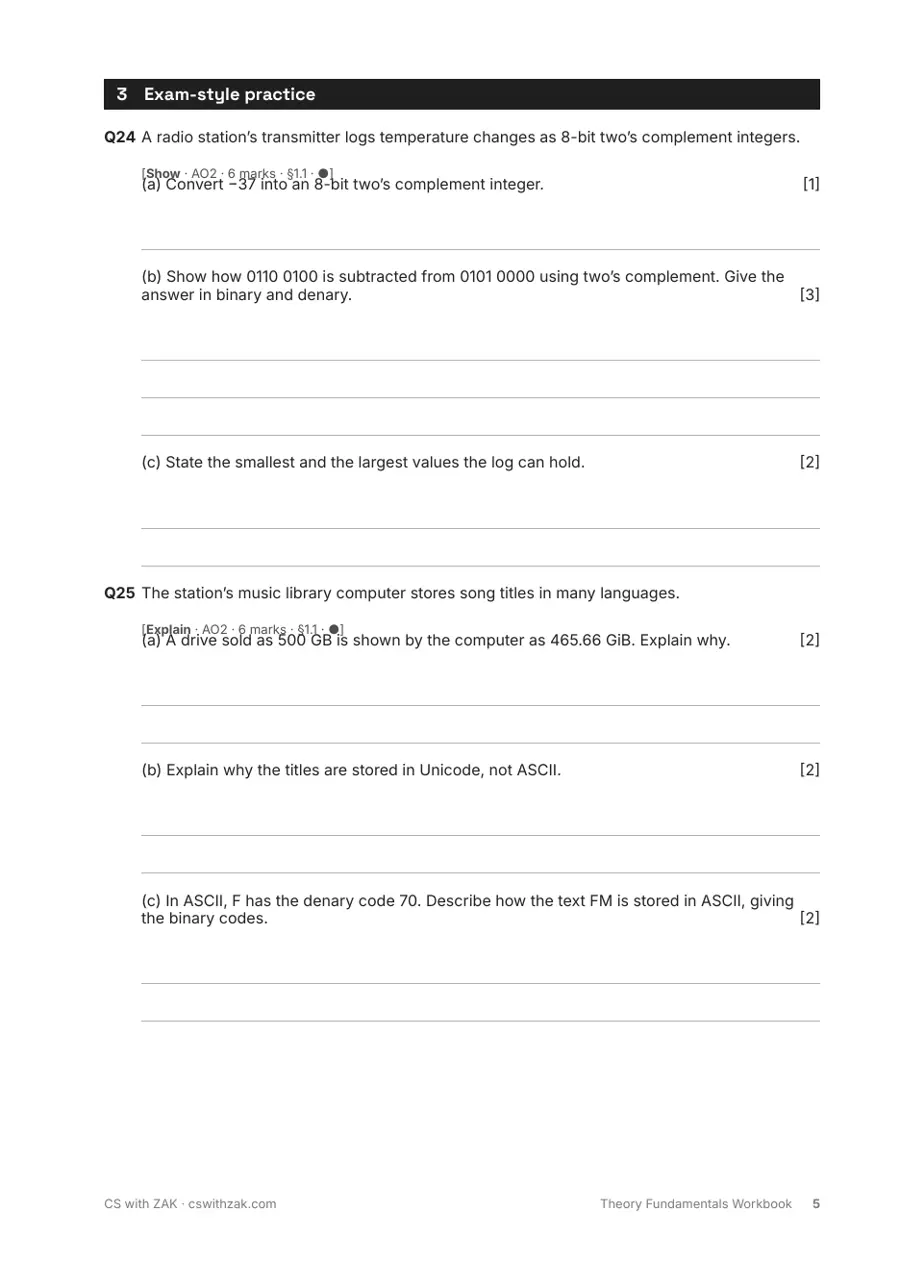
Exam-style practice
Original questions in the exam's own shape — command word, marks and answer lines sized to the marks.
- 4
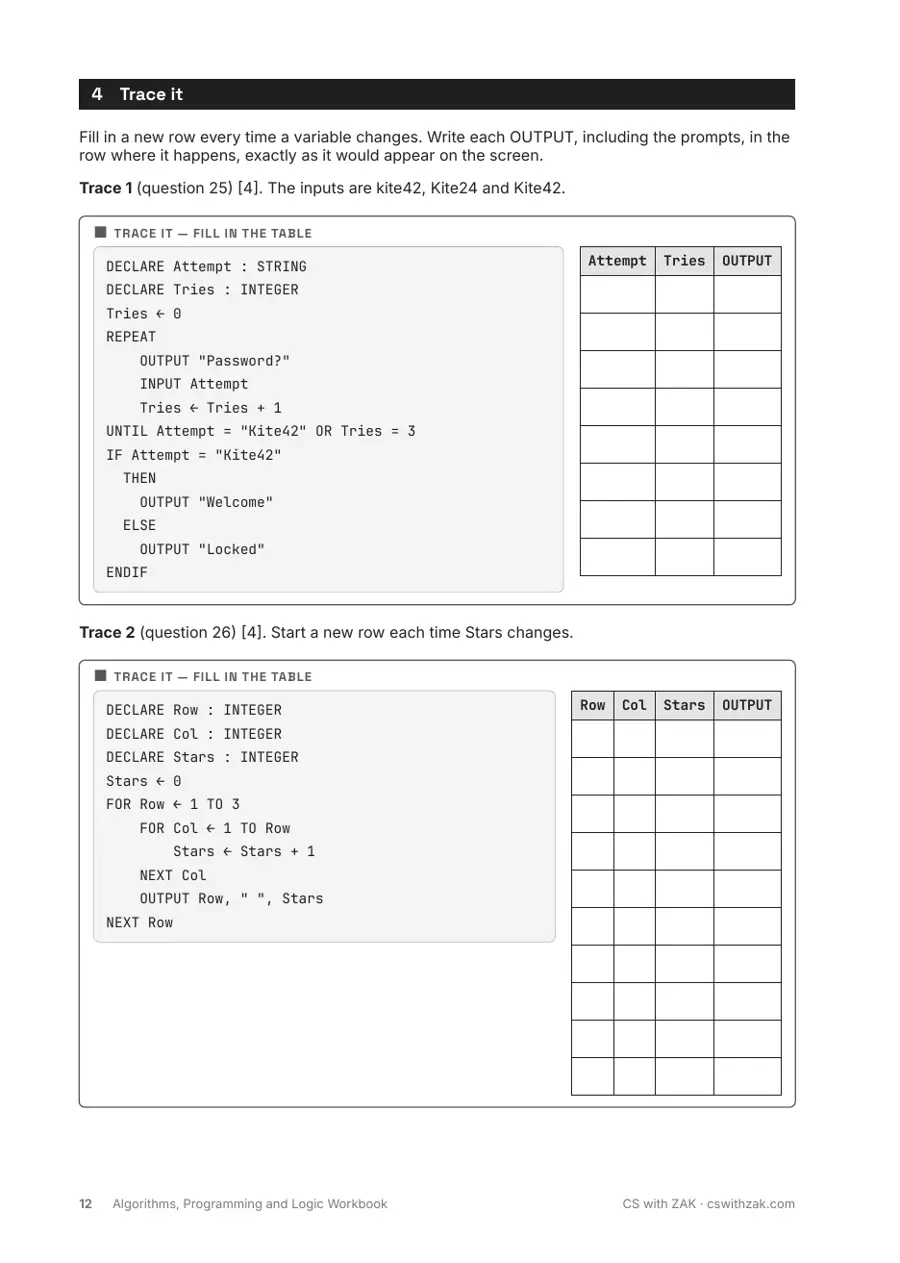
Trace it
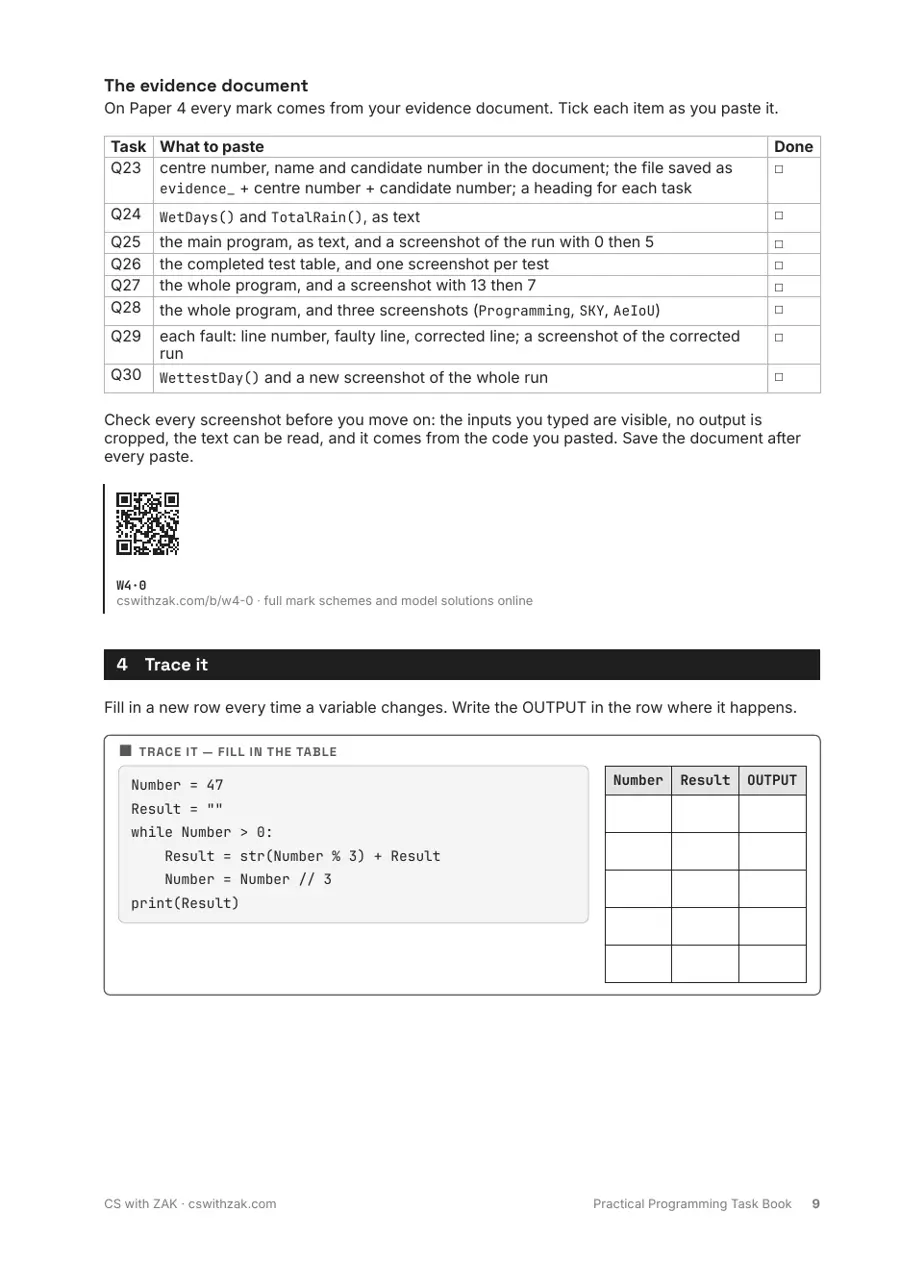
The code on the left, a blank trace table on the right. The skill Paper 2 rewards most.
- 5
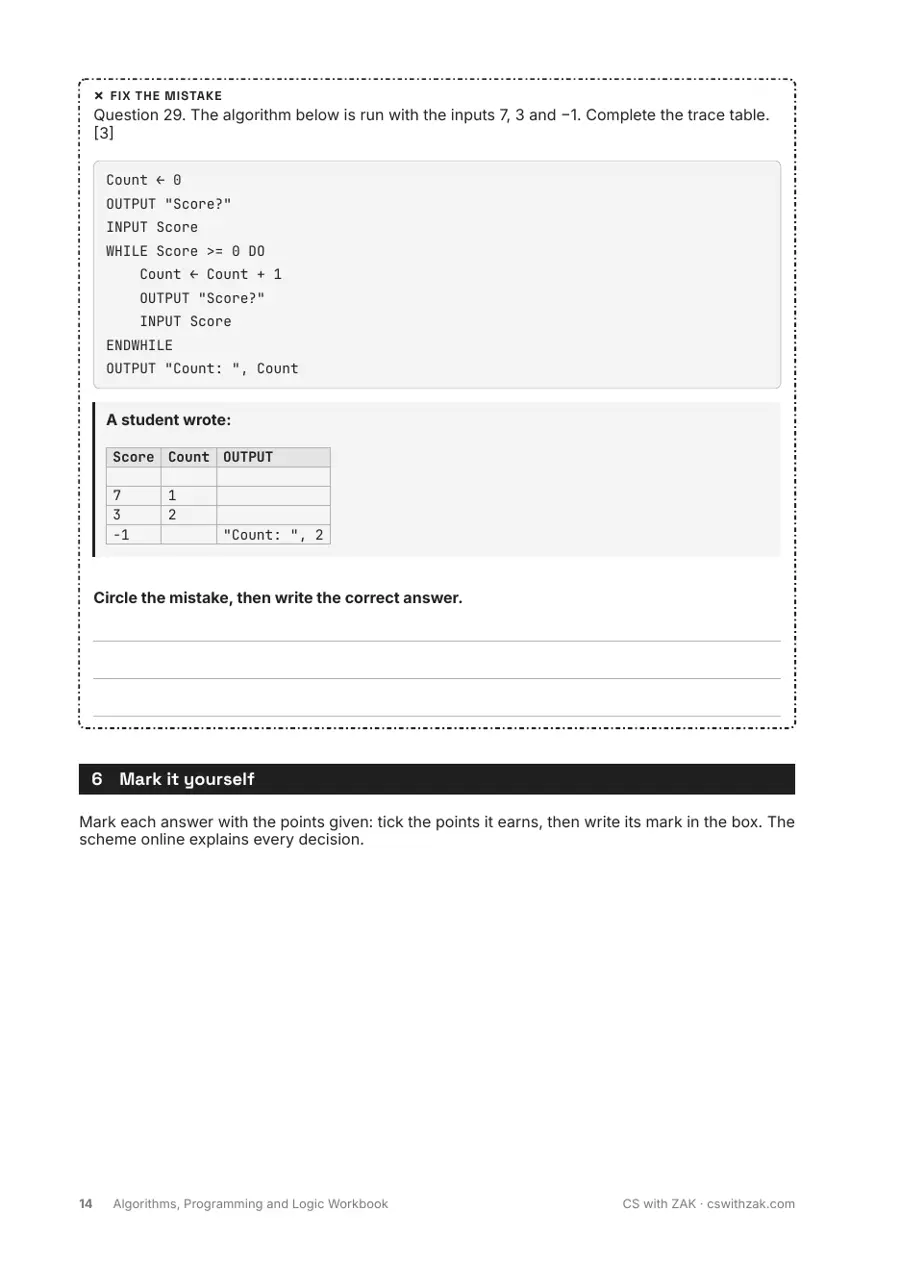
Fix the mistake
Answers that lose marks in the ways examiners report. Cross out, correct, and never make them yourself.
- 6
Mark it yourself
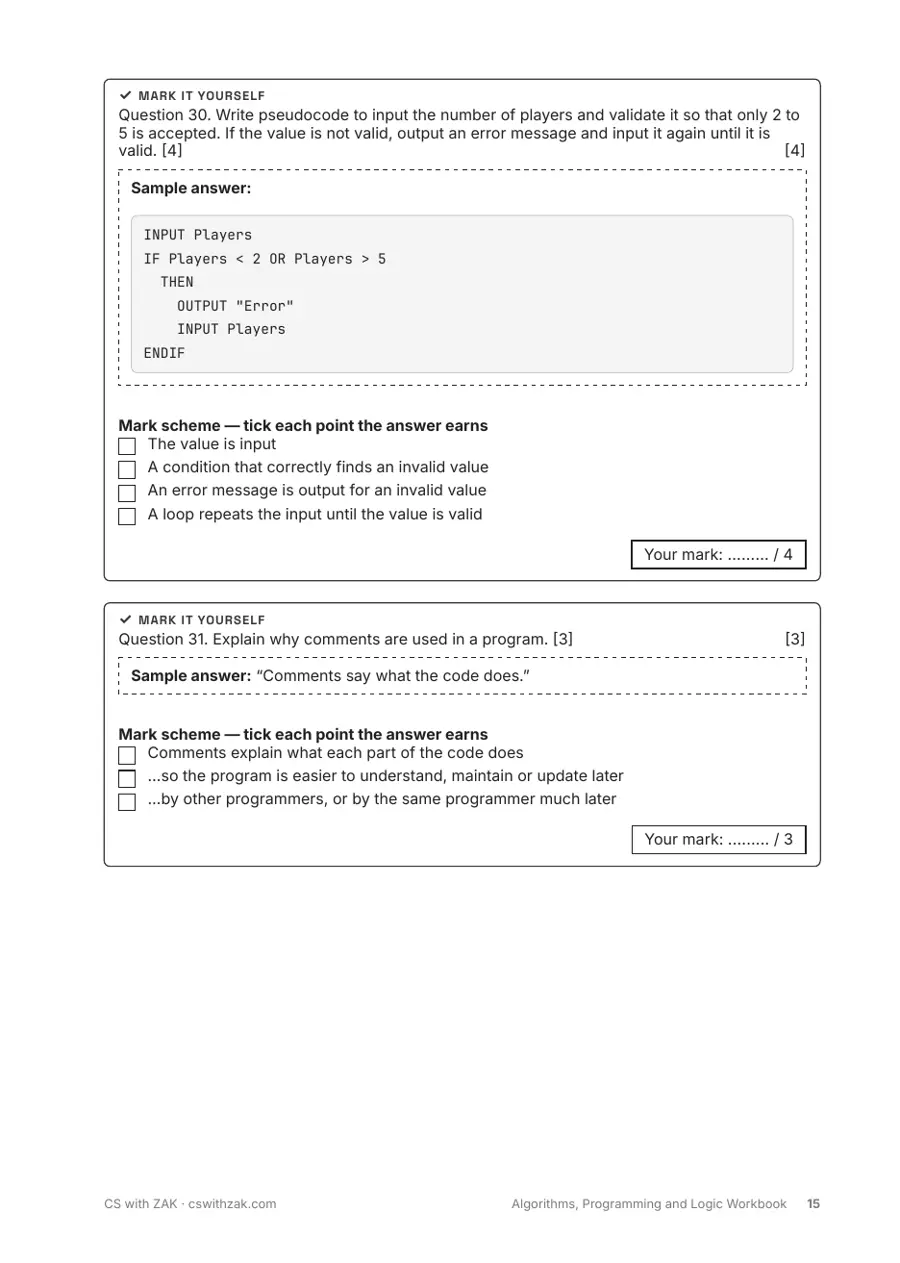
A sample answer and the mark scheme: tick each point it earns. Students learn what the examiner wants by marking.
- 7
Self-check
"Can I…?" statements for every syllabus point, and a teach-it-back task to prove it.
- 8
Full schemes online
A QR code on every page opens the full mark schemes, model solutions and starter files on cswithzak.com.
Look inside
Real pages, from the print files.
Pages from O Level Workbook 2 (Paper 2), Workbook 1 (9618 Paper 1) and the Paper 4 task book.
The workbooks
One for every book.
Same chapter numbers as the books, so a teacher can set the workbook pages for tonight's lesson in one line.
O Level / IGCSE · 2210 · 0478
Workbook 1 · O Level / IGCSE Paper 1
Computer Systems Workbook
Data representation, transmission, hardware, software, the internet and emerging technologies — with answer lines sized to the marks.
- 92 A4 pages
- 198 items · 432 marks
- 36 exam-style questions
- 14 trace tables
Pairs with O Level Book 1: Computer Systems · short code W5
Workbook 2 · O Level / IGCSE Paper 2
Algorithms, Programming and Logic Workbook
Pseudocode, trace tables, validation, arrays, SQL and Boolean logic — with starter files in four languages.
- 90 A4 pages
- 157 items · 378 marks
- 30 exam-style questions
- 10 trace tables
Starter files in Pseudocode, Python, VB.NET, Java
Pairs with O Level Book 2: Algorithms, Programming and Logic · short code W6
Workbook 1 · 2029–2031 · O Level / IGCSE Paper 1
Computer Systems Workbook
Data, logic circuits, networks, cybersecurity, robotics and emerging technologies for the new Python-only syllabus.
- 104 A4 pages
- 227 items · 585 marks
- 42 exam-style questions
- 14 trace tables
Pairs with O Level Book 1: Computer Systems (2029–2031) · short code W7
Workbook 2 · 2029–2031 · O Level / IGCSE Paper 2
Algorithms, Programming and Databases Workbook
Python programming, algorithm design, testing and SQL for the new Python-only Paper 2 — with starter files.
- 90 A4 pages
- 120 items · 315 marks
- 30 exam-style questions
Starter files in Python
Pairs with O Level Book 2: Algorithms, Programming and Databases (2029–2031) · short code W8
AS & A Level · 9618
Workbook 1 · AS Paper 1
Theory Fundamentals Workbook
Data representation, communication, hardware, processors, system software, security, ethics and databases — drilled until the definitions and conversions are automatic.
- 130 A4 pages
- 322 items · 728 marks
- 56 exam-style questions
- 24 trace tables
Pairs with Book 1: Theory Fundamentals · short code W1
Workbook 2 · AS Paper 2
Problem-solving and Programming Skills Workbook
Write precise pseudocode, fill trace tables and fix the algorithms that lose marks — the Paper 2 habits, on paper.
- 95 A4 pages
- 193 items · 449 marks
- 35 exam-style questions
- 14 trace tables
Pairs with Book 2: Fundamental Problem-solving and Programming Skills · short code W2
Workbook 3 · A2 Paper 3
Advanced Theory Workbook
Floating point, protocols, virtual machines, security, AI, computational thinking and further programming — A2 theory that needs practice, not re-reading.
- 140 A4 pages
- 319 items · 739 marks
- 57 exam-style questions
- 24 trace tables
Pairs with Book 3: Advanced Theory · short code W3
Workbook 4 · A2 Paper 4
Practical Programming Task Book
Real Paper 4 tasks with starter files in Python, VB.NET and Java, evidence-document practice and fix-the-code pages.
- 179 A4 pages
- 342 items · 792 marks
- 68 programming tasks
- 22 trace tables
Starter files in Python, VB.NET, Java
Pairs with Book 4: Practical Programming · short code W4
Homework that marks itself — almost
- Set pages by chapter: the numbering matches the book and the syllabus.
- Short drill answers are at the back; full schemes stay online behind a QR code, so the exam-style answers can't simply be copied.
- The workbook Teacher Edition prints the full mark scheme of every item.
- A photocopy licence for your own classes on request — and class sets for the department.
FAQ
About the workbooks.
Do I need the book as well?
The book teaches; the workbook is where you practise. Each workbook follows its book chapter by chapter, so they work best as a pair — but the workbook's questions are all new, so it also works beside class notes or another textbook.
Are the questions the same as in the book?
No. Every workbook question is original and different from the book's, so you are not repeating what you have already answered.
Where are the answers?
Short answers to the drills are at the back of each chapter. Full mark schemes for the exam-style questions are on cswithzak.com, one QR scan from the page — so a teacher can set the workbook without students copying the answers.
Is there a Teacher Edition?
Yes. The workbook Teacher Edition prints the full mark scheme of every item. Teachers can ask the books desk for it.
Can a school photocopy pages?
With a photocopy licence. A school can ask the books desk for written permission to copy pages for its own classes.
Is there an ebook of the workbook?
The workbooks are printed, A4, black and white, so they are made to be written in. The free practice behind each QR code is online for everyone.
Every page's QR code opens the free practice, full schemes and starter files on cswithzak.com.